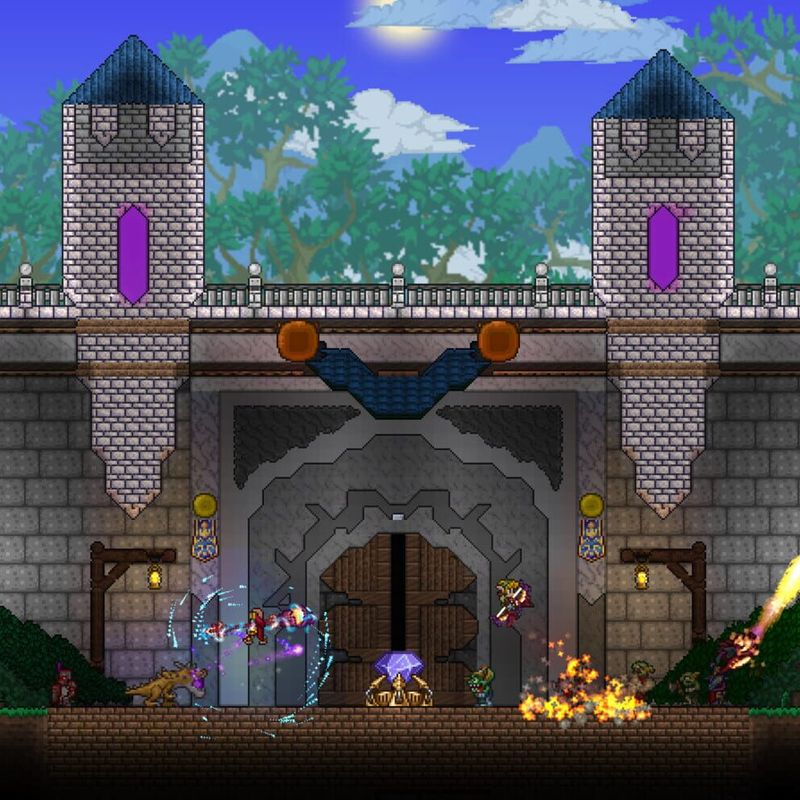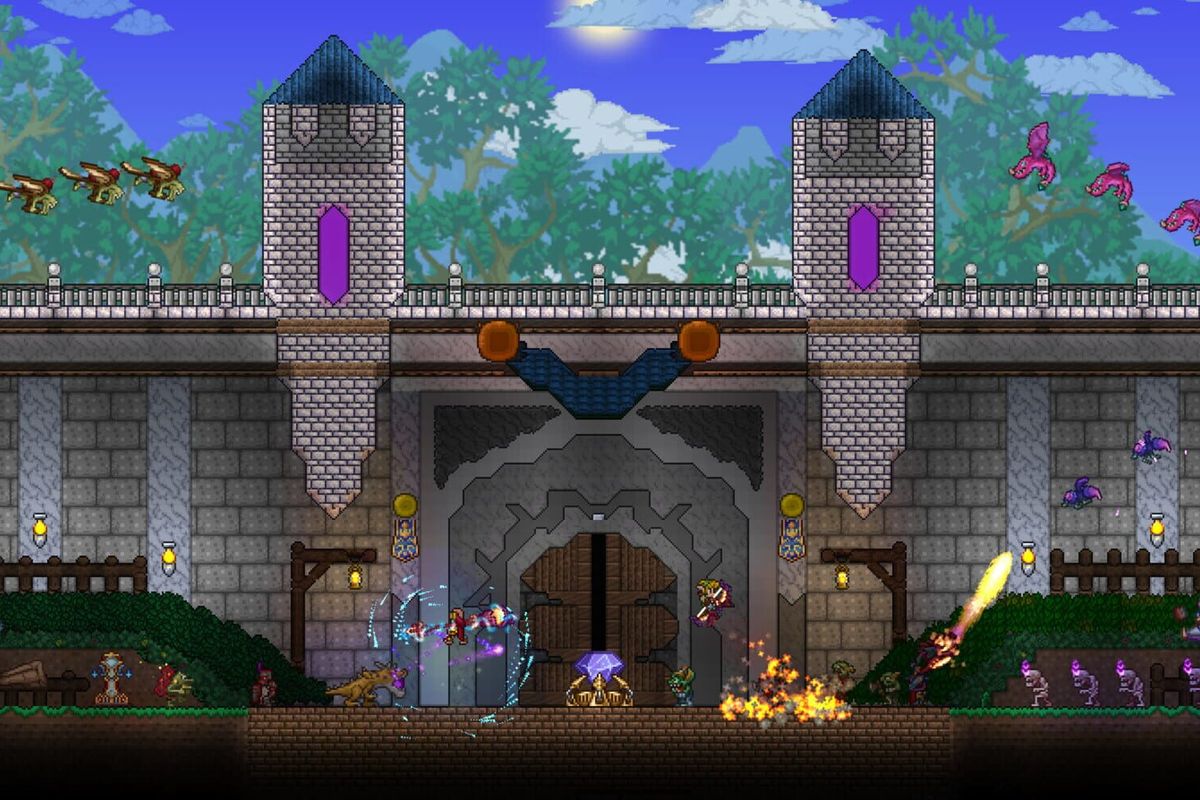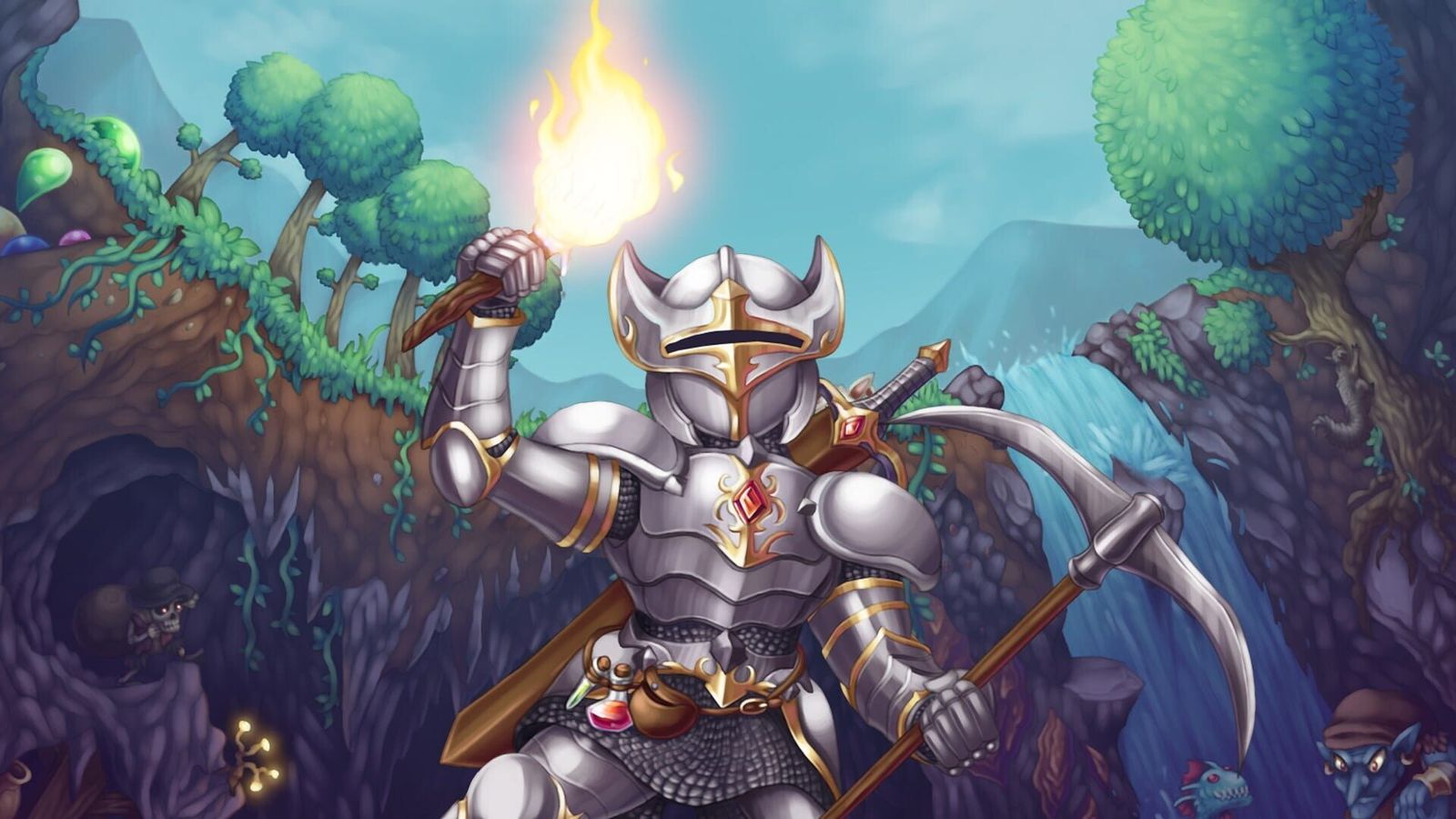
Terraria and Minecraft are not really competing, because they are not selling the same thing. Minecraft sells a platform — a substrate for servers, classrooms, marketplaces and a billion-dollar film. Terraria sells a finished, boss-gated game that has been getting bigger for free for fifteen years at a fixed price of ten dollars. The 350-million-to-70-million sales gap measures reach. It does not measure what a single copy of either one gives you.
The numbers, and what they actually count
Re-Logic announced 70 million copies of Terraria on the game's fifteenth anniversary, 16 May 2026, and did something publishers rarely do: it broke the figure down. PC 39.6 million, mobile 19.7 million, console 10.7 million, summing to exactly 70.0 million. At the thirteen-year mark the total was 58.7 million, so roughly eleven million of those copies were sold in the last two years of a fifteen-year-old game.
Minecraft's figure is over 350 million copies, the number Guinness World Records listed in April 2025 when it recorded Minecraft as the best-selling video game of all time. The previous official milestone was 300 million, announced in October 2023. Five times Terraria's total, from a game whose full release came six months later.
What neither company publishes is how many people are actually playing. Mojang has not released a current global monthly-active-player figure, and the 212-million and 222.5-million numbers that circulate on statistics sites cite a tracker whose own current estimates are far lower and which states plainly that its figures are not official developer counts. Re-Logic, unusually, does publish engagement: in the same anniversary post it gave a past-year PC average of 461,000 players a day, a peak of 1.4 million, and an average playtime of 101 hours 18 minutes.
| Measure | Terraria | Minecraft |
|---|---|---|
| Copies sold | 70 million (Re-Logic, May 2026) | Over 350 million (Guinness, April 2025) |
| Platform split disclosed | PC 39.6M · Mobile 19.7M · Console 10.7M | Not disclosed |
| Monthly active players | Not disclosed | Not disclosed |
| Base PC price | $9.99 | $29.99 and up |
| Price changes since launch | None | Increased |
| Microtransactions | None | Marketplace and Realms Plus |
| Developer | Re-Logic | Mojang Studios |
| First released | 16 May 2011 | 18 November 2011 (full release) |
| Metacritic, PC critics | 83 (29 critics) | 93 (33 critics) |
| On Steam | Yes — 97.4% of 1,556,517 reviews | No |
Update cadence: one slow drumbeat against a quarterly one
Terraria's majors arrive when they arrive. 1.0 in May 2011, 1.1 that December, 1.2 in September 2013, 1.3 in June 2015, then 1.4 “Journey's End” in May 2020 with 1.4.1 five months behind it, 1.4.4 “Labor of Love” in September 2022, and 1.4.5 “Bigger and Boulder” in January 2026. That last gap is three years and four months between major updates — on a game whose developer was posting monthly progress notes throughout.
Minecraft ran the opposite pattern and then changed it. The named annual updates — Caves & Cliffs across two 2021 releases, The Wild Update in June 2022, Trails & Tales in June 2023, Tricky Trials in June 2024 — gave way to smaller, more frequent game drops: four in 2025 in Spring to Life, Chase the Skies, The Copper Age and Mounts of Mayhem, and three so far in 2026, the most recent being Wilderness Bound on 15 September 2026. Version numbering moved to a year-based scheme with 26.1, and Minecraft Live became biannual after September 2024.
Neither rhythm is obviously better, and the comparison cuts both ways. A drop every few months keeps a live game feeling attended to; a three-year gap that ends in an update the size of Bigger and Boulder changes what the game is. The one thing the record does not support is the idea that Terraria has wound down: Re-Logic shipped two updates in August 2026 alone, and has said development continues beyond 1.4.6 and the first phase of crossplay.
| Year | Terraria | Minecraft |
|---|---|---|
| 2020 | 1.4 Journey's End (May); 1.4.1 (Oct) | — |
| 2021 | — | Caves & Cliffs Part I (Jun), Part II (Nov) |
| 2022 | 1.4.4 Labor of Love (Sep) | The Wild Update (Jun) |
| 2023 | — | Trails & Tales (Jun) |
| 2024 | — | Tricky Trials (Jun); game drops begin |
| 2025 | — | Four game drops |
| 2026 | 1.4.5 Bigger and Boulder (Jan) + hotfixes through 1.4.5.8 (Aug) | Three game drops, latest Wilderness Bound (15 Sep) |
The contract each game asks you to sign
This is where the two diverge hardest, and it has nothing to do with blocks. Terraria costs $9.99 on Steam — full price, no discount, when we checked Valve's own storefront API on 20 September 2026 — $14.99 on Switch and $4.99 on iOS. It has never raised that price, has never sold a microtransaction, and in its anniversary post Re-Logic framed the arrangement directly: player support is what lets the studio keep expanding Terraria without falling back on price increases or microtransactions.
Minecraft's is a hybrid, and the clearest sourced description of it is Microsoft's own product copy rather than any design statement. Xbox Wire, July 2025: “Realms Plus subscribers can now add Chase the Skies and Vibrant Visuals content to their own personal servers – and there are also new Marketplace drops included in your subscription.” Free content drops, plus a paid Marketplace, plus a subscription tier, all in one sentence.
The entry price reflects it. The Java & Bedrock Edition bundle for PC is listed at $29.99 and up, with Deluxe at $39.99+ and Ultimate at $49.99+, and it is included with Game Pass. Bedrock on iOS is $6.99 with in-app purchases from $1.99 to $9.99. Paid spin-offs are part of the model too: Minecraft Dungeons II is a $29.99 sequel launching on 29 September 2026, $49.99 for Deluxe, also on Game Pass.
Three times the entry price, a storefront inside the game, a subscription and a retail sequel — against ten dollars, once, since 2011. Both are legitimate businesses. They are just not the same offer.
Design: a progression curve against an open field
Terraria gates its world behind bosses. Each kill changes what spawns, what the merchants stock and which biome is survivable, and beating the Wall of Flesh converts the entire map to Hardmode permanently — an irreversible state change applied to the thing you have spent forty hours building in. Classes exist only through equipped gear. NPC housing and arena construction are mechanical requirements with rules you have to satisfy, not decoration you add when the fighting is done.
Minecraft's only mandated goal is optional. You can travel to the End and kill the ender dragon, or never build a portal. Everything load-bearing about the game's cultural life — redstone computers, public servers, classrooms, the Marketplace, years of accumulated builds — sits outside the progression loop entirely, because there is barely a loop to sit inside. That is a design choice with consequences: it is why Minecraft became infrastructure, and why a Terraria world has an ending in a way a Minecraft world does not.
The counterargument: reach is a design achievement too
The case above is easy to make and worth distrusting, because scale is not an accident. Four things cut against it, and each is as well sourced as anything in the sections above.
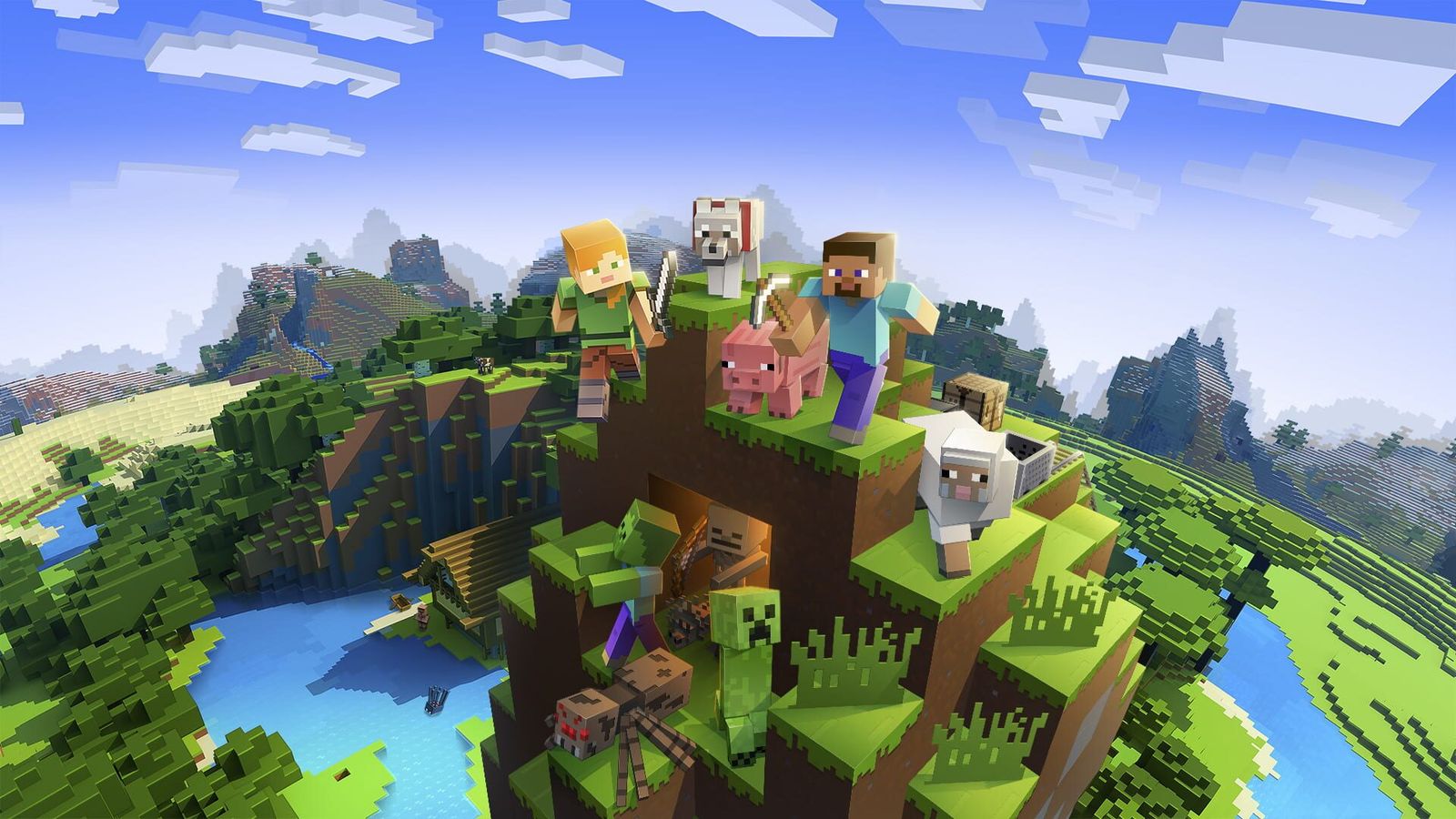
- Minecraft became culture in a way Terraria has not. A Minecraft Movie took roughly $960 million worldwide — $424,087,780 domestic plus $536,300,000 international on a $150 million budget, from an April 2025 release. Terraria has no comparable artefact, and that is a measure of something real.
- Critics rate Minecraft higher. Metacritic's PC page shows Minecraft at 93 from 33 critics, all positive; Terraria's PC critic page shows 83 from 29. A ten-point spread is not noise.
- Minecraft's modding runs an order of magnitude larger per mod. Just Enough Items shows 625.4 million downloads on CurseForge, GeckoLib 409.8 million, Cloth Config API 376.8 million; on Modrinth, Fabric API shows 257.72 million and Sodium 228.12 million. Terraria's largest content mod, Calamity, has 9.76 million Steam Workshop subscribers. The platforms are not equivalent — CurseForge and Modrinth are Minecraft-centric while Terraria modding lives on the Workshop — so compare per-mod scale, not platform totals.
- Minecraft ships on more hardware, and Bedrock's cross-platform play is a genuine structural advantage. Terraria's crossplay is still ahead of it, in an undated 1.4.6. There is also a Minecraft classroom edition with no Terraria equivalent, though no usage statistics for it were verifiable, so treat that as a difference in kind rather than a number.
What we will not offer is the counterargument you would expect: that Terraria's updates have slowed. No credible recent criticism to that effect exists, and the data runs the other way — monthly development posts, two updates in August 2026, and concurrent players climbing through the year. The only mixed Terraria review readily available is a 70 from July 2011, which predates fifteen years of free content.
What the gap actually measures
Here is the head-to-head that survives scrutiny, all of it read off Valve's own endpoints on 20 September 2026: Terraria had 40,434 concurrent players, and all-language Steam reviews of 97.4% positive across 1,556,517 reviews — Overwhelmingly Positive. tModLoader, a free mod loader for a fifteen-year-old game, had 21,570 concurrents of its own, about 53% of the base game. Minecraft is not on Steam, so there is no equivalent review figure to set beside it, and pretending otherwise would be a false equivalence.
So the 350-to-70 gap is real and it is not the answer to anything you were asking. One game has charged $9.99 since 2011, sells nothing else, and is still shipping free content in its fifteenth year. The other became a platform that films, subscriptions, classrooms and sequels are built on, which is why it costs three times as much and has a shop inside it. You can read the Terraria and Minecraft hubs for what each one is doing now, but the choice between them is not a ranking.
FAQ
Has Terraria or Minecraft sold more copies?
Minecraft, by a wide margin. The most recent attributed figure is over 350 million copies, recorded by Guinness World Records in April 2025. Re-Logic announced 70 million Terraria copies in May 2026 — split 39.6 million PC, 19.7 million mobile and 10.7 million console.
Is Terraria cheaper than Minecraft?
Yes, substantially. Terraria is $9.99 on Steam and has never raised its price or sold microtransactions. Minecraft's Java and Bedrock PC bundle is listed at $29.99 and up, alongside a paid Marketplace and the Realms Plus subscription.
Is Terraria still being updated?
Yes. Version 1.4.5 “Bigger and Boulder” arrived in January 2026, fifteen years after launch, with hotfixes through 1.4.5.8 in August 2026. Re-Logic has said updates will continue beyond 1.4.6, which brings the first phase of crossplay.
Is Terraria just a 2D Minecraft?
They share procedural, destructible worlds and little else. Terraria gates its content behind bosses — defeating the Wall of Flesh permanently converts the world to Hardmode — while Minecraft leaves its single optional goal outside the loop entirely.
- Celebrating 15 Years of Terraria — Re-Logic
- Best-selling video game — Guinness World Records
- Game drop — minecraft.wiki
- Java Edition version history — minecraft.wiki
- Minecraft updates: summer 2025 — Xbox Wire
- Minecraft Java & Bedrock Edition for PC — Microsoft
- Terraria on Steam — Valve / Re-Logic
- A Minecraft Movie — Box Office Mojo
- Terraria — Steam charts — SteamCharts
Re-checked Steam figures and prices, and added Minecraft's Wilderness Bound game drop of 15 September 2026.
Published. Sales figures current to Re-Logic's May 2026 announcement and Guinness's April 2025 listing.