All Weapon Types in Monster Hunter Wilds Explained
All 14 Monster Hunter Wilds weapons in one table: what each does, which can guard, and the Offset, Power Clash and Focus Strike each one gets.
Contents
First published. Weapon list checked against Capcom's web manual and official weapon pages.
Monster Hunter Wilds has fourteen weapon types, split eleven Blademaster to three Gunner. That split is not cosmetic: Blademaster weapons carry a passive reduction to physical damage taken, Gunner weapons a passive reduction to elemental damage taken, so the thing in your hands changes what hurts you before you swing it once. Everything else — what each weapon does, which six can guard, which six get an Offset Attack — is in the table below.
One thing to get out of the way first, because every other list you read will imply otherwise: Capcom publishes no official difficulty rating, beginner rating or star score for any weapon in Wilds. We checked the official weapon page and the manual's Weapons Overview, Melee and Ranged pages. There is nothing there. Where this guide gives you a consensus, it names whose consensus it is. The full hub of our Wilds coverage lives here.
How many weapon types are in Monster Hunter Wilds?
Fourteen, unchanged in number from Monster Hunter: World and Monster Hunter Rise. Eleven are Blademaster weapons — Great Sword, Long Sword, Sword & Shield, Dual Blades, Hammer, Hunting Horn, Lance, Gunlance, Switch Axe, Charge Blade and Insect Glaive — and three are Gunner weapons: Light Bowgun, Heavy Bowgun and Bow (manual 8/1, official hunting page).
The two classes also run on different resources. Blademaster weapons consume sharpness, which drains as you attack and drains faster when your hits are deflected. Gunner weapons consume ammo, except the Bow, which burns stamina per shot and loads coatings rather than rounds (manual 8/2, manual 8/3).
A note on spelling, since it affects what you find when you search: Capcom writes Sword & Shield with an ampersand, not “Sword and Shield”.
All 14 weapon types, compared
Names, classes, resources, guard capability and the Blademaster/Gunner split below come from Capcom's web manual and the official weapon page. The mobility column is a relative reading of those same descriptions rather than a published statistic, and the Offset and Power Clash lists in the final column are Game8's documentation, attributed in the sections that follow.
| Weapon | Class | Resource | Can guard? | Mobility | Wilds-specific mechanic |
|---|---|---|---|---|---|
| Great Sword | Blademaster | Sharpness | Yes | Low | Offset Rising Slash · Power Clash |
| Long Sword | Blademaster | Sharpness | No | High | Spirit Gauge turns red, strengthening attacks |
| Sword & Shield | Blademaster | Sharpness | Yes | Very high | Some items usable with the weapon drawn · Power Clash |
| Dual Blades | Blademaster | Sharpness | No | Very high | Demon Mode and Archdemon Mode |
| Hammer | Blademaster | Sharpness | No | Moderate–high | Four delayable Offset variants |
| Hunting Horn | Blademaster | Sharpness | No | Moderate | Melody buffs for the party · Echo Bubbles · Offset Melody |
| Lance | Blademaster | Sharpness | Yes, with counterattack | Low | Guard counters · Power Clash (no Offset Attack) |
| Gunlance | Blademaster | Sharpness + shells | Yes | Low | Shelling and Wyrmstake · Power Clash |
| Switch Axe | Blademaster | Sharpness + phial | No | High | Morphs Axe/Sword · Offset Rising Slash in Axe Mode only |
| Charge Blade | Blademaster | Sharpness + phials | Yes, in Sword Mode | Moderate | Guard points into Power Clash · Savage Axe Mode |
| Insect Glaive | Blademaster | Sharpness + Kinsect | No | Very high, aerial | Kinsect extracts · Offset only with all extracts gathered |
| Light Bowgun | Gunner | Ammo | No | Very high | Rapid Fire Mode on a regenerating energy gauge |
| Heavy Bowgun | Gunner | Ammo | Yes, auto-guard in some states | Low | Ignition Mode · Wyverncounter Ignition offset · Power Clash |
| Bow | Gunner | Coatings (stamina per shot) | No | Very high | Tracers home in on a tagged monster and detonate |
What is an Offset Attack, and which weapons have one?
An Offset Attack is a specific, timed strike that meets a monster's attack head-on instead of avoiding it. Six weapons have one: Great Sword, Switch Axe, Hunting Horn, Hammer, Heavy Bowgun and Insect Glaive. That list is Game8's; the mechanic itself is described on Capcom's official weapon page.
The implementations are not interchangeable. The Great Sword's is the Offset Rising Slash. The Switch Axe has the same move but only in Axe Mode. The Hunting Horn's Offset Melody needs notes prepared in advance and can be held to delay the moment of impact. The Hammer is the outlier with four — Upswing, Spinning Strong Upswing, Charged Upswing and Mighty Charge Upswing — all of which can be delayed. The Heavy Bowgun offsets through Wyverncounter Ignition. The Insect Glaive offsets with a Descending Slash, and only when all Kinsect extracts have been gathered.
What is Power Clash, and which weapons can do it?
Power Clash is the shoving match that follows a perfectly timed guard against certain monster attacks, and it is available only to the guard-capable weapons: Great Sword, Sword & Shield, Lance, Gunlance, Charge Blade and Heavy Bowgun (Game8). Game8 also notes that the button-mashing demand escalates each time you trigger one in the same hunt, so it is not a resource you can lean on indefinitely.
Put the two systems side by side and the roster splits into three groups: weapons that punish an incoming attack by hitting through it, weapons that punish it by stopping it, and weapons that answer it by not being there. The table makes the overlap obvious — only the Great Sword and the Heavy Bowgun have both.
| Weapon | Offset Attack | Power Clash |
|---|---|---|
| Great Sword | Yes | Yes |
| Long Sword | No | No |
| Sword & Shield | No | Yes |
| Dual Blades | No | No |
| Hammer | Yes (four variants) | No |
| Hunting Horn | Yes (Offset Melody) | No |
| Lance | No | Yes |
| Gunlance | No | Yes |
| Switch Axe | Yes (Axe Mode only) | No |
| Charge Blade | No | Yes (from guard points) |
| Insect Glaive | Yes (all extracts required) | No |
| Light Bowgun | No | No |
| Heavy Bowgun | Yes (Wyverncounter Ignition) | Yes |
| Bow | No | No |
What does each weapon's Focus Strike do?
What is official is what a Focus Strike does in general. Wounds open in three stages — a Tear, then an Open Wound, then a Scar once destroyed — attacking a wound increases damage, and a Focus Strike destroys one in a single go, dealing heavy damage and staggering the monster (manual 3/4, official Focus Mode page). That much applies to all fourteen.
What differs per weapon is the animation, the follow-up it opens into and what it spends on the way. Capcom does not publish a per-weapon list of those, which is why you will not find one here presented as fact. Game8's Focus Mode guide documents each weapon's behaviour in detail and is the reference we would send you to — as one outlet's documentation, not as a Capcom specification.
The reason this matters more in Wilds than the equivalent question did in earlier games is that Focus Strikes are where a weapon's damage ceiling now lives. Two weapons with similar raw numbers can feel very different once you account for how quickly each one can convert a wound. That is also the strongest argument for testing rather than reading, which the next section is about.
Which is the best weapon for beginners in Monster Hunter Wilds?
Capcom does not say, and that is the most useful fact in this section. There is no official difficulty rating and no beginner label anywhere on the official weapon page or in the manual's weapon chapters. Any star rating or difficulty tier you have seen was written by an outlet, and it is worth knowing which.
Game8's weapon guide points melee beginners at the Long Sword and Dual Blades and ranged beginners at the Light and Heavy Bowgun, describes the Hammer as having “a simpler gameplay loop for ease of use”, and rates the Charge Blade's difficulty as high. Icy Veins reaches broadly similar conclusions. Treat both as experienced recommendations, which is what they are.
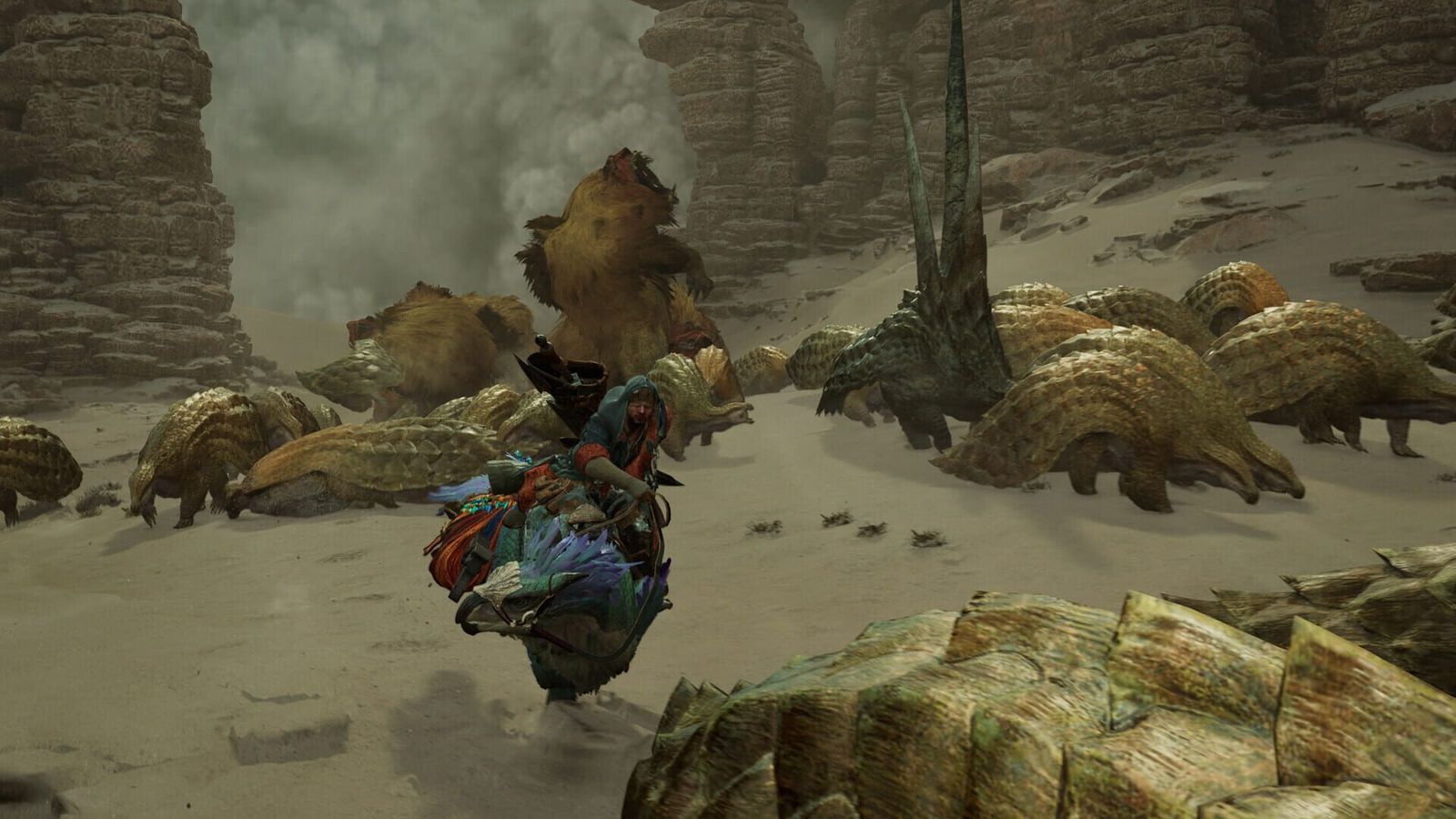
The better answer is structural. Testing every weapon in Wilds is free twice over. The Training Area consumes no items and no bowgun ammo, so you can spend an hour in it without paying for the privilege. And the Seikret's weapon sling means you can carry an unfamiliar weapon into a real hunt alongside one you trust, and bail back to the safe option the moment it goes wrong. That combination is why we would rather hand you the mechanics than a tier list — and why our beginner guide leads with the Seikret rather than a weapon recommendation.
How do you upgrade weapons? Sharpness, decorations and Artian weapons
Sharpness is the maintenance cost of every Blademaster weapon. Capcom: “While you can attack continually, this will eventually decrease the weapon's Sharpness Gauge, reducing the weapon's power and making it easier to deflect.” Deflections then drain it faster, which is the feedback loop that quietly ends hunts. Whetstones restore it and you can sharpen while riding the Seikret (manual 8/2).
Decorations are the other place damage goes missing. Weapon decorations and armor decorations are separate pools and cannot be swapped between them; slots run Lv1 to Lv3, and a higher-level decoration will not fit a lower-level slot (manual 8/5). It is an easy thing to get wrong and a hard thing to notice, which is why it appears in our list of mistakes to avoid as well.
Artian weapons are the endgame system on top of all that. Game8 documents them as unlocking after the Chapter 4 mission “Wyvern Sparks and Rose Thorns”, the first Tempered monster fight, and being forged at the Smithy from Artian parts of matching rarity: Rarity 6 Damaged Shards produce blue sharpness, Rarity 7 Rusted and Rarity 8 Ancient parts produce white. Reinforcement then applies a random bonus drawn from Attack, Affinity, Defense, Element or Sharpness Boost. None of that appears on a Capcom page, so take it as Game8's documentation of the system rather than a published specification.
Fourteen weapons, six that guard, six that offset, and no official ranking to hide behind. The cheapest way to find yours is still the one Capcom built into the game: an unlimited practice room and a mount that carries your second opinion.
FAQ
How many weapons are in Monster Hunter Wilds?
Fourteen, unchanged from Monster Hunter: World and Rise. Eleven are Blademaster weapons, which passively reduce physical damage taken, and three are Gunner weapons — Light Bowgun, Heavy Bowgun and Bow — which reduce elemental damage taken instead.
Which weapons can block in Monster Hunter Wilds?
Great Sword, Sword & Shield, Lance, Gunlance, Charge Blade in Sword Mode, and Heavy Bowgun in some states. Those same weapons are the ones that can trigger Power Clash off a well-timed guard.
Which weapons have an Offset Attack?
Six: Great Sword, Switch Axe, Hunting Horn, Hammer, Heavy Bowgun and Insect Glaive. Switch Axe only offsets in Axe Mode, and Insect Glaive only when all Kinsect extracts are gathered. Lance does not have one.
What's the easiest weapon to start with?
Capcom publishes no official difficulty ratings. Guide consensus points beginners at Long Sword or Dual Blades for melee and the bowguns for ranged, with Hammer cited for its simpler loop. Charge Blade is widely rated the hardest.
Can you change weapons mid-hunt?
Yes. The Seikret carries a second weapon in its sling and you can swap to it at any time. Pressing the swap button on foot summons the Seikret first.
- Weapons Overview — official web manual — Capcom
- Melee Weapon Features — official web manual — Capcom
- Ranged Weapon Features — official web manual — Capcom
- Weapons — Monster Hunter Wilds official site — Capcom
- Offset Attacks guide — Game8
- Power Clash guide — Game8
- Focus Mode — official web manual — Capcom
- Monster Hunter Wilds — Focus Mode — Capcom
- Monster Hunter Wilds — Hunting — Capcom
- Decorations and talismans — official web manual — Capcom
- Focus Mode guide, including per-weapon Focus Strikes — Game8
- Best weapon tier list and weapon guide — Game8
- Artian weapons guide — Game8
- Weapon type list — Icy Veins